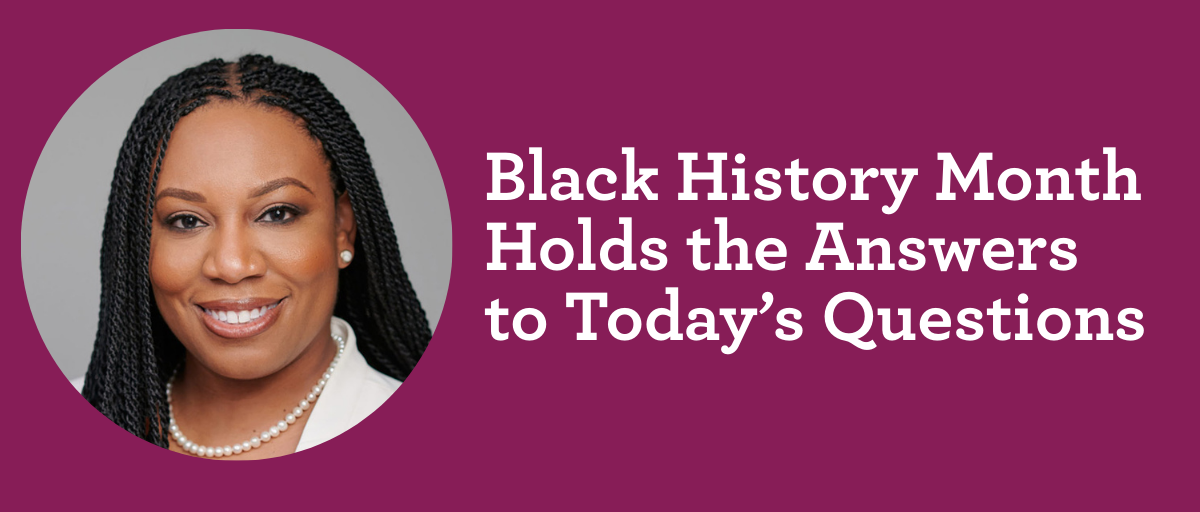
From the Desk of Imani
Black History Holds the Answers to Today’s Questions
When I reflect on Black History Month, I think of the brilliant Black science fiction writer Octavia Butler. Her work masterfully tied together social justice and speculative futures. People often say she predicted the future. But what Butler really understood was power. She understood patterns. She understood what happens when fear, hierarchy, and oppression go unchecked.
In 2000, in an interview with Essence, Butler was asked what the answer was to the disasters she imagined. She said,
“There’s no single answer that will solve all our future problems…Instead, there are thousands of answers–at least. You can be one of them if you choose to be”.
I’ve returned to that quote again and again over the past year, but especially in recent weeks. Not only because what we are witnessing can accurately be described as disaster, but because the need for those thousands of answers has never been clearer.
If there were ever a reminder that anti-Blackness remains foundational in American politics, it was the President of the United States posting a racist image of the Obamas and then gaslighting the public about what we all plainly saw.
The Trump administration uses gaslighting as a political tool. Some of the most powerful people in this country are trying to convince us that cruelty is normal; that injustice is exaggerated, that the harm we witness is imagined.
They want us to ignore the reality of people dying in ICE custody. They want us to ignore masked agents using violent, and deadly force without accountability. Being surveilled, rounded up, brutalized, and killed by law enforcement is not an abstraction. It is a lived reality for far too many in this country.
Black history also teaches us to be in solidarity with every underrepresented group facing discrimination.
The attacks on our rights, our access, and our dignity feel relentless. That is not accidental. Overwhelm is a strategy. Exhaustion is a strategy. Fear is a strategy. When people are tired and isolated, they are easier to silence.
They want us to be too discouraged to act. Too hopeless to organize. Too divided to see what is happening to all of us.
But our history tells a different story.
Black communities have always understood the radical truth that oppression of any of us is the oppression of all of us. Fights for racial justice, LGBTQ rights, immigrant justice, reproductive freedom, economic justice and in every fight for civil rights, solidarity has been our greatest defense and our greatest strength.
They try to undermine our storytelling because our stories have the power to change culture. Culture changes policy. Policy changes our lives.
Our stories change the world.
This month, the most powerful way we can honor Black History Month is to refuse isolation. Refuse the lie that we are alone and that we don’t see what is right in front of us.
Choose to be one of the thousands of answers.
Litigation Updates
What we are experiencing is unprecedented and frightening. The Trump administration is ignoring civil rights laws, fostering discrimination, and weaponizing the Department of Justice and other federal agencies to attack our communities, healthcare, employment protections, educational institutions, data privacy, and our families. Its laser focus on LGBTQ people and immigrants is designed to terrorize us into silence.
It’s not working. Since Trump took office, attorneys have filed hundreds of lawsuits challenging his abusive policies, delaying or stopping them entirely. As one of NCLR’s senior staff attorneys, I am focused on this critical litigation and will continue to be for as long as it takes.
But our non-litigation work is just as essential. Every time we slow down or stop an anti-LGBTQ policy, it is a victory—and two recent projects stand out.
Improper Subpoenas
In July 2025, under the guise of investigating healthcare “fraud,” the DOJ sent more than 20 subpoenas to hospitals and medical providers that treat transgender minors, demanding access to children’s confidential healthcare records—billing documents, prescriptions, social security numbers, addresses, and records showing the medical history of patients and their families.
NCLR quickly mobilized with other LGBTQ organizations, creating a fact sheet to notify parents and connect them with legal resources. We also worked directly with families whose records were targeted to provide immediate legal help.
Some hospitals are fighting back—and winning. Every court that has reviewed the subpoenas so far has found them improper, motivated by animus, and unrelated to any law the DOJ enforces, and has issued orders protecting families’ private medical information. And because of our network, other lawsuits are ready if and when they are needed.
Defending Kids from Online Harassment
Even before Trump took office, NCLR saw a surge in online and in-person harassment of transgender children. Trolls post children’s private information to scare and harass their families and to mobilize others – often within their local communities – to target them in-person.
These actions are deeply harmful, especially to kids who have no online presence and don’t want vicious abuse to be the first thing that appears when someone searches their name.
NCLR treats these actions as what they are: deliberate threats designed to harm children and their families. We are working to stop this abuse and hold harassers accountable through litigation, legislation, and advocacy. Some states have laws against doxxing and online harassment, but many more need them. No child should have their private information weaponized against them—and no parent should have to endure watching it happen.
Trump’s attacks are frightening and destabilizing, but people are fighting back. From Minnesota to Chicago to Los Angeles and everywhere in between, attorneys are filing cases to stop or delay the administration’s unlawful actions, and communities are mobilizing and looking out for each other. We have no illusions that we can always win. But each time this administration tries to normalize violence against our communities, we must respond.
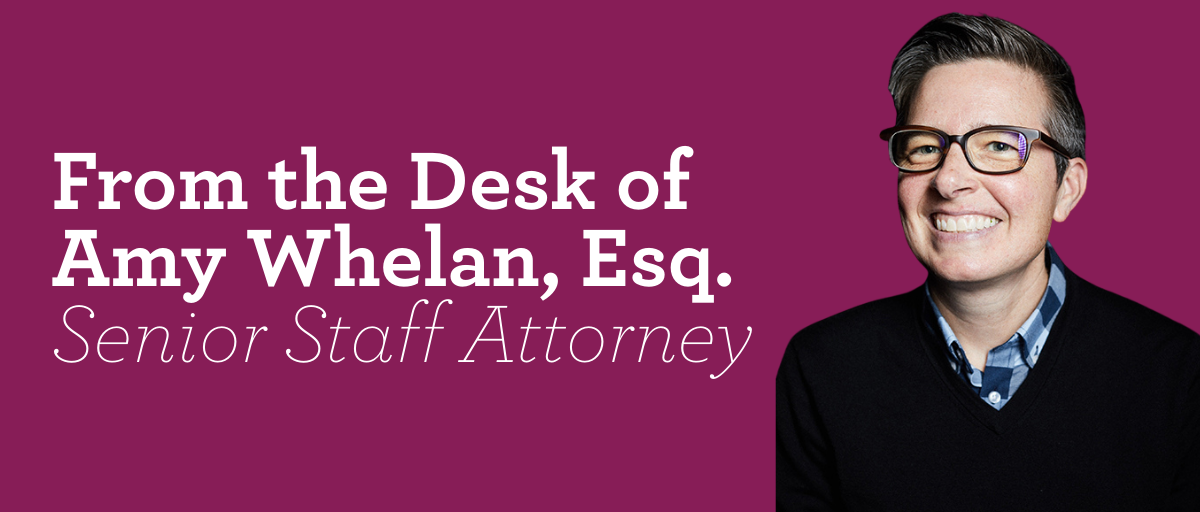
Amy Whelan
Senior Staff Attorney

NCLR To Host LGBTQ Rights Conference For Legal Aid Advocates
NCLR, the California Women’s Law Center (CWLC), and Legal Aid Association of California (LAAC) will be co-hosting the LGBTQ Rights Conference for Legal Aid Advocates on March 12–13, 2026. This two-day, MCLE-accredited conference in San Francisco will bring together attorneys, advocates, and community partners dedicated to advancing justice for LGBTQ+ clients across California.
Conference goals are to:
- Share updates on current legal and political developments affecting LGBTQ+ communities;
- Strengthen cultural competency and practical advocacy skills within legal aid programs;
- Support networking and collaboration among advocates statewide and;
- Build a stronger, more connected community of practice committed to equity and inclusion.
In-person slots are full but you can still register as a virtual attendee or join the waiting list for an in-person spot.
The L-Fund Honors NCLR President Imani Rupert-Gordon
NCLR President Imani Rupert-Gordon will be honored by The L-Fund in Palm Springs on March 14. The L-Fund is recognizing Imani with the Bobreta Franklin Community Service Award. Bobreta was one of the founders of the L-Fund and dedicated her life to service and to the lesbian community. For more information and tickets to the L-Fund’s Gala visit: Upcoming Events – The L-Fund

Champions for Justice 2026
NCLR’s Champions for Justice Gala is not to be missed! With Comedian Irene Tu as host and special guests to be revealed, you’ll want to secure your table before it’s too late!
Ways to Give
Did you know that after the age of 72 you are required to withdraw funds from your IRA or retirement account each year? It’s true, and the income is taxable! For those of you who turned 73 in 2025, you have until April 1, 2026 to take your first RMD.
Because these funds can be taxed, some IRA and retirement plan holders choose to leverage their required minimum distribution for good and distribute the amount to causes they care about. Called Qualified Charitable Distributions – or QCDs – this type of charitable giving can be extremely impactful, and QCDs do not impact your taxable income!
Learn more about required minimum distributions: Retirement plan and IRA required minimum distributions FAQs | Internal Revenue Service
This type of charitable giving requires a bit of planning. If you are interested in making a qualified charitable distribution to NCLR, please reach out to us at development@nclrights.org or contact your financial adviser.
And if you are already using QCDs to support NCLR’s work, thank you!
NCLR in the News
How Trump Is Remaking America — State by State – The New York Times
Trump asylum policies endanger LGBTQ+ migrants, lawyers warn | Advocate.com
DOJ misled judges on trans military ban new filing states | Advocate.com
Skeptical federal judges question Trump trans military ban | Advocate.com
Trans students still protected in California — for now – CalMatters
Horizons Foundation President Doughty to step down
Anti-transgender legislation accelerates in early 2026
LGBTQ Agenda: NCLR sounds alarm about queer asylum seekers