WHY STATE PROTECTIONS FOR TRANSGENDER PEOPLE MATTER NOW MORE THAN EVER
For nearly five decades, the National Center for LGBTQ Rights has fought to secure legal equality for LGBTQ people. Today, that fight has taken on a new urgency. The federal government, which once served as a backstop against discrimination, has become its principal engine. In this moment, state-level protections are not a supplement to federal civil rights law—they are the front line.
The scope of the current federal assault is staggering. Since taking office in January 2025, Trump has issued a relentless barrage of executive orders seeking to eliminate any legal protection or recognition of transgender people: banning them from military service, reversing federal anti-discrimination protections, preventing transgender people from obtaining federal ID, and directing the Bureau of Prisons to transfer incarcerated transgender women into men’s facilities regardless of the documented risk of violence and sexual assault. Our legal team is meeting these attacks in court.
In Talbott v. USA, NCLR and our partners have secured rulings halting the discharge of transgender service members—decorated, qualified patriots whom the administration seeks to expel for no reason but animus—as we prepare for trial. In Doe v. Blanche, we won injunctions protecting transgender women in federal custody from transfers that would deliberately expose them to extreme danger. We have gone to court on behalf of California families to stop the Justice Department from using a sweeping out-of-state grand jury subpoena to seize their children’s confidential medical records from California children’s hospitals—an act of pure intimidation, unsupported by any evidence of wrongdoing, that strikes at the heart of the doctor-patient relationship.
But litigation against federal overreach is only half the battle. After United States v. Skrmetti, in which the Supreme Court upheld Tennessee’s ban on health care for transgender adolescents, the states have become the decisive arena. In states like Florida, where legislatures have enacted their own bans—laws NCLR has challenged on behalf of transgender youth and their parents—young people suffer. When states protect access to care, families can breathe. That is why we are representing California families suing Rady Children’s Health to stop a hospital system from unlawfully cutting off care that state law protects. Strong state nondiscrimination laws, health care protections, and privacy safeguards are what stand between transgender people and a federal government determined to harm them.
State protections for youth are equally vital in the wake of Chiles v. Salazar. More than twenty states have banned the discredited and dangerous practice of so-called conversion therapy, which every major medical and mental health organization condemns. This spring, the Supreme Court held that Colorado’s ban, as applied to talk therapy, must satisfy strict First Amendment scrutiny. The ruling is a setback—but it is not the end. The Court did not question the overwhelming evidence that conversion therapy harms children, and it pointed toward the tools states retain: malpractice liability, consumer protection law, and carefully drawn regulation of professional conduct. NCLR has launched a new state-level strategy to help legislatures update their conversion therapy laws to incorporate the Court’s guidance—ensuring that survivors can hold practitioners accountable and that these protections rest on the firmest possible constitutional footing.
The lesson of this moment is clear. Federal hostility makes state action indispensable. Every state nondiscrimination statute, every conversion therapy protection, every shield law for transgender health care is a lifeline. NCLR will keep fighting in federal court to stop the worst of these attacks—but we will also keep working state by state, because that is where transgender people’s daily lives are lived, and where their rights can still be made real.
-Shannon Minter, NCLR Legal Director

NCLR HOGAR {HOME} CLIENT ANTONIA RECEIVES ASYLUM
As immigrants and asylum seekers face increasing threats of violence and dangerous escalations from DHS, NCLR is deepening our commitment to our Hogar {Home} clients. For more than 30 years, NCLR has represented LGBTQ immigrants seeking a safe home in the United States, and even in this political climate, we are securing wins to support our clients.
For example, Antonia* is a transgender woman from Mexico who experienced severe and repeated violence in Mexico and fled to the U.S. after receiving death threats from a group of men who had violently attacked her for being transgender. She requested asylum at the border and was initially placed in immigration detention but was later released, and she eventually found her way to San Francisco.
Because she was originally stopped at the border, Antonia’s case was in immigration court when she first came to NCLR for legal help. Immigration court cases are significantly more difficult than cases at the asylum office, both because clients require legal representation and because asylum seekers have to testify about the danger they faced in their home country in open court. Despite these challenges, Antonia was able to tell her story, and with the help of NCLR — and after nearly 10 years of uncertainty — she was granted asylum!
*we have changed our client’s name to protect her privacy
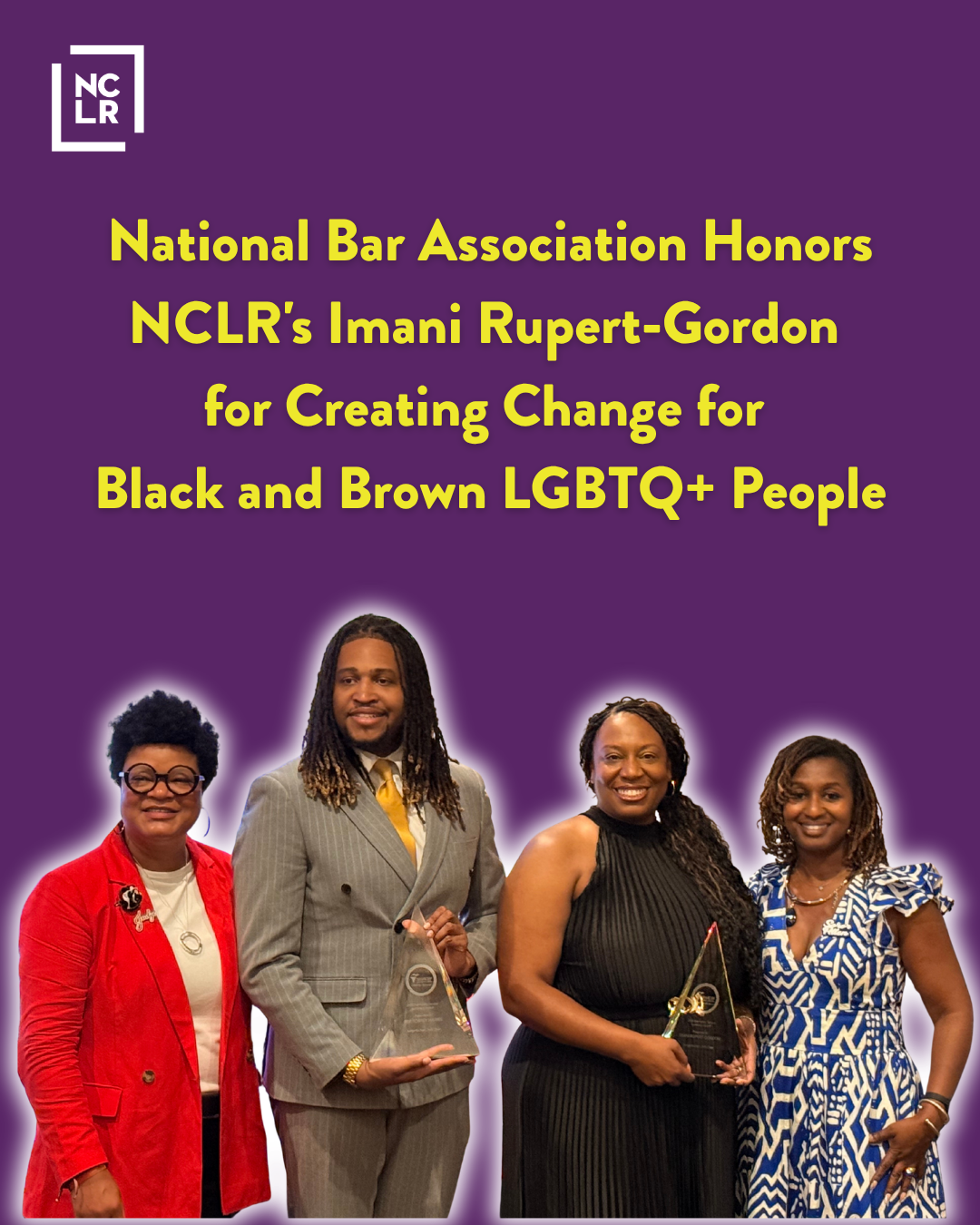
NCLR PRESIDENT IMANI RUPERT-GORDON RECEIVES THE EXEMPLARY SERVICE LUMINARY AWARD FROM THE LGBTQ+ DIVISION OF THE NATIONAL BAR ASSOCIATION
The National Bar Association honored NCLR’s Imani Rupert-Gordon for Creating Change for Black and Brown LGBTQ+ People. Imani received the Exemplary Service Luminary Award from the LGBTQ+ Division of the National Bar association for her outstanding service to produce measurable change for Black and Brown LGBTQ Individuals.
Imani also joined Judge Rachel Bell in conversation about NCLR’s decades of work on LGBTQ sports inclusion before an audience of judges and lawyers as part of a CLE panel focused on the future of transgender sports following this most recent Supreme Court Decision. Congratulations to Imani and all the Luminary award recipients!

NEWSFLASH! AUGUST IS MAKE-A-WILL MONTH
August is Make-A-Will Month. Legacy planning may not be top of mind, but having a will is important, and could have a huge impact on the future of NCLR’s work for LGBTQ justice.
During your planning, you could make the critical decision to make NCLR a beneficiary of your estate. It’s a deeply meaningful gift for the LGBTQ community and movement that costs nothing now and would create an impact that lives on.
Learn more about planned giving.
There’s no better time than now to make a commitment to the future of our movement.

NCLR Out Loud
TIME, “Trump’s New Medicaid Rule Targets Gender-Affirming Care for Minors,” by Rebecca Schneid, Aug. 12, 2026. Quoting NCLR Legal Director Shannon Minter on the impact of this rule and other Trump administration policies that force transgender people to suppress who they are and create suffering.
The New York Times, “Hegseth Plans to Screen All Troops, Including Women, for Low Testosterone: Pete Hegseth, as defense secretary, has sought to cultivate an image as a manosphere-friendly leader,” by Greg Jaffe and Azeen Ghorayshi, July 15, 2026. Quoting NCLR Legal Director Shannon Minter making clear that a policy banning transgender troops for taking the same medication is pure bias and a blatant double standard.
CBS News, “Filipina Woman Says California’s LGBTQ Protections Inspired Her Bay Area Move,” by Sooji Nam, Aug. 10, 2026. A Transgender History Month piece quoting NCLR Legal Director Shannon Minter about California as a refuge for transgender people.
Capital B, “Families Fear Georgia’s Trans Athlete Ban Will Harm Black Children,” by Alyssa Johnson and Naji Rutherford, Aug. 13, 2026. Quoting NCLR Legal Director Shannon Minter on how anti-trans legislation harms all women and girls.
The Denver Gazette, “Transgender Prisoners File to Keep Identities Concealed After Female Plaintiffs Identified Inmates as Sex Offenders,” by Mia Cathell, Aug. 4, 2026. Citing NCLR’s case to protect transgender women from sexual assault in prison.
Military.com, “Transgender Air Force Master Sergeant at Center of US Government Lawsuit Calls New Court Ruling ‘Meaningful‘. Air Force Master Sergeant Logan Ireland spoke to Military.com after a DOJ motion was denied Wednesday by a federal court,” by Nick Mordowanec, July 24, 2026.
The Advocate, “Judge in trans military ban case demands Pentagon explain Hegseth’s testosterone double standard. Judge Ana Reyes is demanding answers about a policy that offers testosterone to some troops while citing hormone care to remove others,” by Christopher Wiggins, July 22, 2026.
The Advocate, “DOJ says it will ask U.S. Supreme Court to undo block on Trump’s transgender military ban. An appeals court found that current service members were likely to prevail, but the Trump administration wants that ruling kept on hold,” by Christopher Wiggins, July 16, 2026.